Three Things Amelia Ransom Said About Mentoring That I’m Still Thinking About

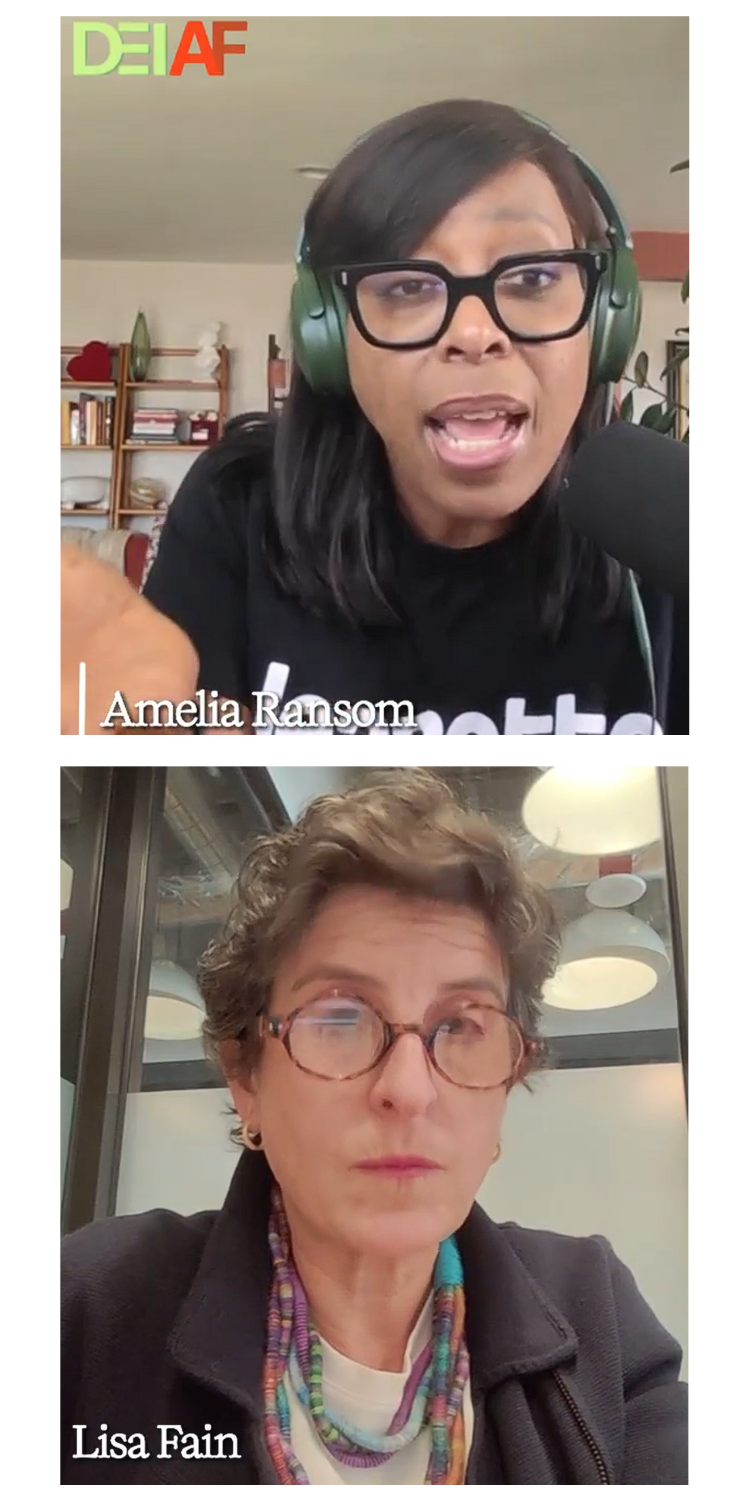
I recently joined Amelia Ransom on her DEI AF podcast for a conversation about mentoring, sponsorship, learning, AI, and what it really takes to grow.

Amelia has a gift for putting big ideas into memorable language. Three things she said during our conversation have stayed with me.

1. “Don’t be a learning thief.”

I loved Amelia’s phrase “learning thief.”

It describes what happens when mentors enter a relationship assuming all the learning is supposed to flow in one direction: I’m the experienced person. I’m here to teach you.

My take: Great mentoring is reciprocal.

A mentor may bring experience, context, and perspective, but the mentee brings knowledge, experiences, and ways of seeing the world the mentor doesn’t have.

Come to mentoring prepared to contribute—but also prepared to learn.

Otherwise, you may be leaving half the value of the relationship on the table.

2. “What do you need to know to be true about me to advocate for me when I’m not in the room?”

Amelia shared a question she asked her COO:

“What do you need to know to be true about me to advocate for me when I’m not in the room?”

That is such a powerful sponsorship question.

It moves beyond, What should I work on? or even What do you think of me? It asks a senior leader to name what they would need to know, observe, or believe before putting their own credibility behind you.

Amelia then talked about taking that information back to her mentor and working on those things—if they rang true for her.

My take: This is exactly why no single developmental relationship can do everything.

A sponsor can advocate for you.  They can tell you what they would need to see in order to advocate for you.

A mentor can help you reflect on that feedback, decide what is relevant, build the capability, and think through how to demonstrate it authentically.

Different people play different roles in our growth.

That is the power of a learning ecosystem: not relying on one person to provide everything you need, but intentionally building a network of relationships that provide different kinds of perspective, challenge, support, and access.

3. “AI can transfer knowledge, but it can’t give you nuance.”

Later in our conversation, Amelia offered a series of observations about AI that stopped me in my tracks:

“I’m not afraid of AI. I’m afraid of us.”

“AI can tell you what it said, but not what it is saying.”

And:

“AI can transfer knowledge, but it can’t give you nuance.”

My take:

There is no shortcut to human connection.

AI can give us information. It can transfer knowledge. It can summarize, synthesize, and help us see patterns.

But nuance lives in relationship.

It lives in the trust that makes it possible to say the thing that is hard to say – or as Amelia puts it “to say the quiet things out loud.”

That kind of learning requires human connection.

There is no shortcut to it.

This is why I don’t believe AI makes developmental relationships less important.

It makes them more important.

AI scales information.

Relationships scale wisdom.

As access to knowledge becomes easier, our ability to interpret it, question it, contextualize it, and exercise sound judgment becomes even more valuable.

And we develop those capacities with—and through—other people.

The thread connecting all these observations is this:

Don’t just receive learning. Participate in it.

Take charge of your own learning.  Be willing to learn from the people you mentor. Ask what others need to know to advocate for you.   Be both mentor and mentee, sponsor and protégé. Build a network of relationships that helps you reflect, stretch, interpret, and act.

Growth isn’t simply about accumulating more information.

It is about becoming better at making meaning from it—and surrounding yourself with the people who help you do that.

That is what a true learning ecosystem makes possible.

You can watch my full conversation with Amelia Ransom on DEI AF here: https://www.youtube.com/watch?v=0V1vSmNKOf8

For more information and resources, visit:  www.centerformentoring.com or www.lisazfain.com
The Empty Room Denim Bar

If AI can teach people almost anything, what is the role of mentoring now?

Imagine a new hire, fresh from college, top talent recruited for a high-performing team. We can call her Whitney.

Whitney is six months into her role. She is bright, capable, and resourceful. When she gets stuck, she opens an AI tool.

She asks it to explain the new market she is working in. She asks it to draft an email to a senior stakeholder. She asks it to summarize notes from a meeting she barely understood. It does all these things, well and quickly.

In many ways, Whitney is moving faster than she could have a few years ago. She is not waiting for someone to teach her the basics or wondering where to start.

Her company sees this as a win. They are so pleased with the efficiencies of AI that, instead of investing in mentoring, they have invested in AI coaching as their primary development tool. The message, though no one says it quite this plainly, is: Why build mentoring when people can get answers instantly?

For Whitney, something is missing.

AI can’t identify which stakeholder really needs to be consulted before the proposal goes forward. AI can’t help her understand why one very influential leader nodded enthusiastically in the meeting but sent a skeptical email afterward. It can’t help her discern whether her colleague’s stony reaction is par for the course or a sign of misalignment. It can’t teach her, in context, how to raise a concern without sounding difficult, or how to tell whether silence in the room means agreement, resistance, or fatigue.

She feels disconnected from context and isolated by her independence. AI cannot help her with that.

Whitney’s manager holds her accountable for performance: the report, the deck, the deadline, the client response. But no one is holding her accountable for her growth. No one is asking what she is learning, where she is stretching, what patterns she is noticing, or what kind of judgment she is developing.

Whitney’s work looks good enough that everyone assumes she is fine.

She isn’t fine. Her skills are underutilized. She is producing without developing. She is answering questions without building confidence. She is surrounded by tools and still has nowhere to turn.

Eventually, Whitney realizes she needs more than answers. She needs people.

She reaches out to someone in another department whose judgment she admires. Not with a grand request to “be my mentor forever,” but with a specific invitation: “I’m trying to get better at reading stakeholder dynamics. Would you be willing to talk with me once a month for the next few months?”

That relationship changes something.

Her mentor does not simply give her advice. She provides context. She helps Whitney see the organization more clearly. She challenges Whitney’s assumptions, shares her own mistakes, and points out patterns Whitney had missed.

Over time, Whitney begins to use AI differently too.

Instead of asking AI for the answer, she asks it to help her prepare: What questions should I bring? What assumptions might I be making? How can I reflect on what I heard? Where do I need more context from a human being?

AI becomes a tool for preparation and reflection. The relationship becomes the place where judgment is built.

This is where the question gets real: If AI can teach people almost anything, what is the role of mentoring now?

The answer is that mentoring was never just about teaching.

At its best, mentoring is about development. It is about connection, reciprocal learning, shared sense-making, feedback, encouragement, perspective, accountability, and access. It is not merely the transfer of knowledge. It is a relationship that helps people interpret experience, build judgment, navigate complexity, and become more capable than they would be on their own.

In an AI-shaped workplace, that role becomes more important, not less.

This relationship is just a starting point for Whitney. She does not need one all-knowing mentor to hand her every answer. She needs a developmental network: a mentor who can help her make sense of experience, a connector who can help her understand the unwritten rules, a challenger who will sharpen her thinking, a sponsor who will say her name in rooms she is not yet in, a peer who will compare notes honestly, and a manager who sees development as more than task completion.

Organizations need this too. They cannot simply give people AI tools and assume growth will follow. Output is not the same as development. Efficiency is not the same as judgment. Access to information is not the same as access to wisdom.

AI does not replace the human relationships that help us make meaning, build courage, exercise judgment, and contribute fully.

AI hasn’t made mentoring obsolete. It has made human intelligence and connection even more essential to ensuring talent is fully realized.

For more information and resources, visit:  www.centerformentoring.com or www.lisazfain.com

AI and mentoring

The Empty Room That Taught Me About Connection

For 17 years, we lived in Chicago.

I built a career there. I started a family there. I raised babies there. I learned how to be an adult there, in the blunt, beautiful, exhausting way adulthood often teaches us: long hours, longer commutes, too much to carry, not quite enough money in the bank, and a calendar that looked full but somehow did not feel sustaining.

My marriage was strong. My work was satisfying. Our life was good in many ways.

And still, I was lonely.

Not lonely in the dramatic, abandoned-on-a-mountaintop sense. I had people around me. We had great neighbors. We had couple friends we liked and saw now and then. I had work colleagues, fellow parents, people I genuinely enjoyed.

But I did not have the kind of deep female friendship I ached for. I missed the easy camaraderie I had known with my college friends, the shorthand, the kinship, the sense of being known without having to explain the whole backstory every time. Those friends were scattered around the country, and I found myself longing for something I could not seem to build where I was.

I remember hearing the advice that if you want to have friends, you have to be a good friend. So, I tried.

I volunteered. I joined parent committees. I showed up in religious and civic spaces. I invited work colleagues to lunch. I looked for ways to offer generosity and kindness, hoping that if I kept extending myself, something would take root.

One moment from that time has stuck with me:

At a charity silent auction, I bid on – and won – a party for 20 at a denim bar. At the time, this was a new and lively concept: a place where you could go, get fitted for a great pair of jeans, have a little fun, maybe drink something bubbly, and leave feeling slightly more fabulous than when you walked in.

I thought it would be a perfect way to gather a group of women.

So, I invited women I knew and liked. I bought refreshments. I watched the responses come in through Evite. About 10 women said yes.

The night of the party, I set everything up and waited.

At the appointed hour, no one came.

Forty-five minutes passed.

Finally, one person walked in.

We laughed a little, tried on jeans, made our purchases and called it a night.

Then I went home and cried.

I did not cry because I felt embarrassed, though I did. I did not cry because people were cruel, because they were not. People are busy. They forget. They have sick kids and deadlines and traffic and lives with their own invisible weather systems.

I cried because the empty room told me something I already feared was true: I had not built the kind of relationships my soul needed.

For years, I thought about that night as a painful, slightly humiliating story about friendship.

But over time, I understood it differently.

The problem was not simply that I needed more friends. The problem was that I was looking for friendship as if it were one thing. One magical circle. One group that would offer belonging, fun, honesty, encouragement, accountability, perspective, challenge, and care.

What I really needed was not one perfect community.

I needed an ecosystem.

That realization became even clearer after I moved to Seattle, a city famous for the so-called Seattle Freeze. I braced myself for distance. Instead, in a relatively short period of time, I found myself surrounded by a richer, more nourishing web of relationships than I had experienced in all my years in Chicago.

Part of that was timing. Part of it was openness. Part of it was luck.

But part of it was that I had changed.

I was no longer waiting for friendship or support to appear fully formed. I had become more intentional about seeking different relationships for different purposes.

At the same time, I hired a coach. I joined a mastermind of women entrepreneurs. I built relationships that were not centered on our children or our spouses or our proximity, but on mutual curiosity, shared growth, and the willingness to tell each other the truth.

And slowly, I began to see the pattern.

Some relationships helped me feel known.

Some helped me think bigger.

Some challenged the stories I was telling myself.

Some opened doors.

Some reminded me to rest.

Some helped me sharpen my ideas.

Some held up a mirror.

Some held my hand.

None of these relationships had to be everything. Together, they became enough.

What This Taught Me About Mentoring

That insight changed how I think about mentoring, leadership, and growth too.

For years, we have treated mentoring as if it requires finding one wise person who will guide us. The mentor. The sage. The person with the answers. But that model is too narrow for the complexity of real life and real work.

No one person can be our challenger, sponsor, connector, truth-teller, strategist, encourager, role model, and safe harbor.

And when we expect one person to do all of that, we often end up disappointed. Or we do not ask at all, because the ask feels too big.

But when we begin to think in terms of a developmental network, everything changes.

The Power of a Developmental Network

A developmental network is the constellation of people who help us grow. It may include mentors, peers, sponsors, coaches, colleagues, friends, former bosses, clients, teachers, and people who see something in us before we fully see it ourselves.

It is not about collecting contacts or even about networking in the transactional sense.

It is about building the relationships that help us become more courageous, more discerning, more useful, and more fully ourselves.

That is the heart of my message now.

Growth does not happen in isolation. Better judgment does not develop in a vacuum. Impact does not come from rugged individualism, no matter how much our culture romanticizes it.

We grow through relationship.

We make better decisions when we have people who help us see what we cannot see alone.

We become braver when we have people who remind us of who we are becoming.

We create more impact when we stop waiting to be chosen, rescued, or discovered, and instead begin to design the network that helps us contribute at a higher level.

Looking back, I have compassion for the woman standing in that denim bar with her refreshments and her hopeful little Evite list.

She was not needy or foolish or failing.

She was seeking.

Hungry for the relationships that would help her feel more rooted, more supported, more alive.

I still believe in generosity. I still believe in being a good friend. But I no longer believe that support is something we should leave to chance.

We must be more intentional than that.

We can ask: Who helps me think? Who helps me tell the truth? Who helps me grow? Who helps me remember what matters? Who opens doors? Who challenges me with care? Who do I support in return?

This is not about being a joiner.

It is about being a seeker.

A learner.

A connector.

Most of all, it’s about being a designer of the relationships that make a bigger life, and a bigger contribution, possible.


For more information and resources, visit:  www.centerformentoring.com or www.lisazfain.com

The Empty Room Denim Bar