by Center for Mentoring Excellence | Mar 29, 2014 | Group Mentoring
Group mentoring offers some very rich opportunities for promoting group and individual learning.
While group mentoring multiplies the learning, it can only do so when members of the group intentionally and effectively work at strengthening relationships between and among themselves.
What are some of the most common pitfalls to avoid when it comes to group mentoring?
 1. Jumpstarting the process without first building trust. Too often group mentoring participants — particularly peer mentors — are so eager to get started that they jump right into mentoring without taking enough time to establish and build trust among themselves. In group mentoring, all mentoring partners must feel safe before they can feel comfortable enough to be open with one another and to experience significant learning.
 2. Failure to acknowledge difference. It is easy to assume that by virtue of being in a group, group members share common interests. While it is quite true that they may share some things in common, they are unique individuals and each brings who they are into the relationship. When members fail to understand their own and each other’s’ uniqueness, they miss out on the opportunity to learn from different perspectives.
 3. Not fully committed to the process. When individuals are required to participate in group mentoring, they may fail to engage fully in the process. They may choose instead to sit back passively or withhold their opinions. Inevitably, it is the group that misses out. Lack of engagement impacts the learning of the entire group.
 4. Failure to engage in conversation. Mentoring groups may sometimes say that they engage in “conversation.” What they are actually doing, though, is participating in a series of transactions or interactions. It is only when mentoring partners fully engage in conversation that deeper insights emerge. Conversation that demands collaborative engagement accelerates learning and takes group mentoring to a whole new level.
by Center for Mentoring Excellence | Mar 22, 2014 | Group Mentoring
There appears to be a groundswell of interest in group mentoring. New formats and forms of group mentoring are emerging all the time and in different industries and setting around the globe.
In group mentoring individuals either mentor each other or rely on one or more individuals to facilitate the learning of a group of mentees. Mentoring groups can be peer-led or facilitated by one or more experts who serve as group mentors.
10 Best Practices for Getting Group Mentoring Started
- Get to know the members of your group— not just their business titles but who they are as people.
- Clarify the purpose of the group. What is the purpose of your group and what do you want to accomplish?
- Decide on the process you are going to follow. Who will lead the group? What process will be used to make sure that participants receive what they need from the group?
- Define roles and responsibilities of group members so that each participant is clear about what is expected of them.
- Make everyone feel safe by putting confidentiality agreements in place.
- Talk about personal and group boundaries and how to address potential stumbling blocks, when and if they occur.
- Establish an agreed-upon set of ground rules. Will there be an agenda? When is the group going to meet? What happens if someone’s attendance is inconsistent or infrequent?
- Discuss each person’s learning style and how individual learning styles might affect the learning that goes on in the group.
- Agree on when and how to bring the group to positive closure. How will you know it is time for the group to come to closure?
- Establish an accountability process to help the group and its members stay on track. Is the group meeting its goals?
by Center for Mentoring Excellence | Mar 4, 2014 | Uncategorized
Without the presence of learning, mentoring doesn’t exist. It is the purpose, the process, and the product of a mentoring relationship.
Because learning is so central to mentoring, it is essential that mentors understand their mentees as learners. Mentors need to know how to engage and guide the mentee appropriately and to create a climate that supports learning. In addition, mentors must to be open to learning themselves. When you begin your relationship mentor and mentee should agree to the purpose.
What is it that the mentee wants to obtain from your meetings? Once you have figured out what you both are going to receive from the relationship, it is now time to plan the process. How frequently will we meet? What will our meetings consist of? What goals will the mentor set for the mentee? Finally, decided what you want to end product to be. Where do both mentor and mentee want to be after the relationship comes to a close? How will you measure your accomplishments?
by Center for Mentoring Excellence | Feb 6, 2014 | Mentoring Training
Why should you invest in mentoring training? The biggest reason is that when it comes right down to it, most people are unprepared or underprepared for their mentoring roles. Without competency and comfort in the role, it is hard to feel confident and to be good at mentoring.
There are some pretty powerful payoffs for mentoring training.
1. Mentoring training builds more confident and competent mentors and mentees.
2. Mentoring training promotes participant readiness by getting everyone on the same page.
3. Mentoring training sets a standard for mentoring practice.
4. Mentoring training clarifies assumptions about mentoring and communicates expectations.
5. Mentoring training provides guidelines for mentoring success.
6. Mentoring training provides an opportunity to develop and practice mentoring skills
7. Mentoring training skills are easily transferable to other types of workplace relationships.
by Center for Mentoring Excellence | Dec 17, 2013 | Making Mentoring Work For You, Mentoring Relationships
It’s holiday time and gift-giving is on everyone’s mind. But how about those intangible gifts that are not wrapped up in packages and tied with a bow?
Time is one of them. When you carve out the time to mentor someone it is indeed a very special gift. Your gift of time tells that person that they matter to you, and that you value them. On the other hand, when you repeatedly postpone or cancel meetings, it sends a different message– my time is too valuable for you, our time together isn’t important or you are not worth the investment of my time.
 Remember Stephen Covey’s Four Quadrant Model? Covey makes the distinction between urgent and not urgent activities and those things that are important and not important. Urgent and important items are the crises, pressing problems and deadlines that get most of our attention. We tend to put off things that are deemed important, but are not urgent – like mentoring and personal development. Because they lack urgency nothing compels us to act immediately. Like many people, you might find yourself putting mentoring on the back burner, confident that you will get to it when the crisis du jour is over. Even with the best of intentions you don’t, because sooner or later another crisis takes its place.
If you are waiting to find the time to give to mentoring others, forget it. You will never find the time unless you make sure you make it a priority. Time has a way of slipping by and with it goes the opportunity to make a difference in someone’s life.
What You Can Do
- Put mentoring dates and time on your calendar well in advance.
- Commit making time for mentoring a priority.
- If you have to reschedule, do it ASAP.
- Select the tasks, assignments, decisions, etc. you can delegate to someone else so you can free up your calendar. (Ideally, your delegation should provide an opportunity for someone else to grow and develop.)
- Use planning and time management strategies to make good use of the time you do have.
Questions to Consider
- Where does the priority of mentoring currently fit in your world?
- Who could really benefit from quality time with you?
- How available and accessible are you to the people who need you?
- What tasks are you doing now that someone else could do?
by Center for Mentoring Excellence | Dec 10, 2013 | Uncategorized
Congratulations. Your mentoring program received high marks this year. Training sessions were packed. Website usage tripled. The degree of satisfaction with mentoring matches surpassed last year. You’ve received a ton of accolades. But are these high marks enough to declare your mentoring program a success? (more…)
by Center for Mentoring Excellence | Dec 6, 2013 | Making Mentoring Work For You
It is not too early to begin thinking about your new year’s resolutions. We’d like to suggest that while you plan on improving your health, fitness, and financials in 2014, you also think about powering up your personal mentoring practice.

If you are motivated to raise your bar on mentoring next year, here are a few ways to turn your intentions into to a reality:
#1: Identify lessons learned. Make time to sit back and reflect on your mentoring experiences this year. What did you learn from your mentoring partner(s)? How are you using what you learned?
#2: Celebrate strengths. Think about what it is you did or said that worked particularly well in your mentoring relationships. Be as specific as you can. If you’ve kept a mentoring journal, now is the time to take another look at it. Plan to maximize your assets in the New Year.
#3: Recognize missed opportunities. We all have experiences that we wish had gone better. We may not have expressed something that needed to be said, candy-coated feedback when we could have been more forthright, or not followed through on something we’d promised. What do you wish had gone better in your mentoring relationships this past year? What got in your way? Ask your mentoring partners for feedback.
#4: Identify growth opportunities. In what ways have you grown as a mentor or a mentee? What new approaches have you tried this past year? In what ways, have you challenged and stretched yourself? Are you more effective in your mentoring role now than you were a year ago? How can you accelerate your gains this coming year?
#5: Develop a game plan. Identify specific skills, approaches and competencies you need to learn and develop to take your personal mentoring practice to the next level. Then, consider how you are going to go about acquiring the skills and knowledge you need to move forward. Craft a development plan that includes milestones and time frames and opportunities to try out new skills.
Remember: No matter how many times you engage in mentoring you can always get better at your practice. There is no better time to start than right now.

by Center for Mentoring Excellence | Dec 6, 2013 | Uncategorized
We recently asked participants at a seminar to raise their hand if they were informally mentoring someone. Almost everyone in the room held their hand up. We told those folks to keep their hand raised if the answer was yes to the following question: “Would that person, if they were sitting next to you right now, say they were being mentored by you?” Almost all the hands dropped. (more…)
by Center for Mentoring Excellence | Aug 25, 2013 | Uncategorized
Some of the many mentoring benefits for individuals include accelerated learning, expanded and diverse perspectives, increased tacit organizational knowledge, additional insights about other business units, improved skills in specific areas ( for example, listening, building relationships). Mentoring also offers individuals a trusted sounding board, role model, and/or go-to individual. Individuals often say that as a result of mentoring they feel more self-aware and self-confident, connected more closely to the organization, and find work more satisfying and meaningful. (more…)
by Center for Mentoring Excellence | Aug 25, 2013 | Mentoring Training

Why should our organization invest in mentoring training? Don’t most people just naturally know how to do it?
The fact of the matter is that most people are either unprepared or underprepared for their mentoring roles. Mentoring training builds more confident and competent mentors and mentees. It promotes participant readiness, creates a standard of mentoring practice, provides guidelines for ensuring mentoring success and offers a safe climate of support.
Senior leaders in our organization are excused from training. Are we missing the boat?
Yes you are. Mentoring is a leadership competency and that means even veteran mentors can grow in the role and become better at the work of mentoring. It is not uncommon to hear comments like, “I am not sure what I am doing here. I’ve mentored people all my life,” or, “I’m showing up because I was told to… not sure there is anything new under the sun on this topic.” 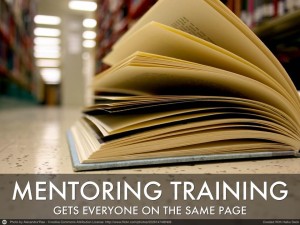 When leaders show up for mentoring it sends a clear message about the value of mentoring and mentoring training that cascades down into the organization. It also enhances the quality of the mentoring experience for everyone gathered in the training room. Programs morph over time and your mentoring program may have changed from when it first began. You will want to make sure everyone is on the same page when it comes to mentoring. Mentoring training is just the ticket.
What kind of mentoring training is best?
Your mentoring education “menu” should include an array of training opportunities. You will want to consider providing training opportunities for those engaged in formal as well as informal mentoring. Provide options for meeting diverse learning needs at multiple levels and entry points, whether acquiring basic mentoring information and concepts, mentoring relationship preparation, mentoring skill competency, advanced mentoring, and renewal opportunities.
What approach should we take to creating an action agenda for our mentoring training?
There are many innovative practice models and ideas for delivering mentoring education and training, including some very novel approaches. Some organizations adopt an annual thematic approach (usually linked to organizational priorities) to keep mentoring education and training fresh. Some offer introductory, mid-level and advance mentoring courses on a rotating or cyclical basis. Others have certain basic requirements for core courses and electives and award CEUs (continuing education units) or mentoring certificates for fulfilling these requirements.
 1. Jumpstarting the process without first building trust. Too often group mentoring participants — particularly peer mentors — are so eager to get started that they jump right into mentoring without taking enough time to establish and build trust among themselves. In group mentoring, all mentoring partners must feel safe before they can feel comfortable enough to be open with one another and to experience significant learning.
 2. Failure to acknowledge difference. It is easy to assume that by virtue of being in a group, group members share common interests. While it is quite true that they may share some things in common, they are unique individuals and each brings who they are into the relationship. When members fail to understand their own and each other’s’ uniqueness, they miss out on the opportunity to learn from different perspectives.
 3. Not fully committed to the process. When individuals are required to participate in group mentoring, they may fail to engage fully in the process. They may choose instead to sit back passively or withhold their opinions. Inevitably, it is the group that misses out. Lack of engagement impacts the learning of the entire group.
 4. Failure to engage in conversation. Mentoring groups may sometimes say that they engage in “conversation.” What they are actually doing, though, is participating in a series of transactions or interactions. It is only when mentoring partners fully engage in conversation that deeper insights emerge. Conversation that demands collaborative engagement accelerates learning and takes group mentoring to a whole new level.