by Center for Mentoring Excellence | Aug 2, 2012 | Uncategorized
Mentees, especially those new to mentoring, often think that it is presumptuous to ask their mentors for what they need. Sometimes it is the fear of intimidation; the mentor’s position and power in the organization that gets in the way. And sometimes, it is sheer gratitude and respect for a mentee’s time and attention that precludes a mentee from asking for what she needs. (more…)

by Center for Mentoring Excellence | Jul 29, 2012 | Growth and Development
Can you recall the last time when you were engaged openly and respectfully in two-way, free-flowing really great and meaningful conversation? If you are like most people you can probably recall one or two such occasions even though you may be engaging in real conversation less and less these days.
It is ironic that in the very process of connecting with each other, we are actually becoming more and more disconnected. Technology has made connecting more expedient but, at the same time, it has affected how we interact and engage with each other.
Mentoring relationships run the risk of becoming a series of sound bites (text and IM) instead of real conversations. Engaging in conversation increases trust and facilitates learning in a mentoring relationship.
We developed the Levels of Conversation model to illustrate how trust and learning expand relative to the level of conversation that takes place in a mentoring relationship.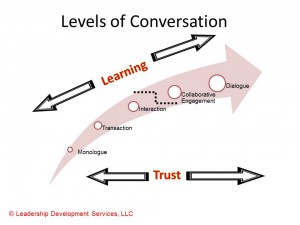
Monologue is essentially a non-conversation. It shuts down, rather than invites, conversation. It doesn’t build trust or promote learning. One or the other party claims all the airspace for storytelling, lecturing or expounding.
Most people engage in transaction when they mean to be in conversation. The conversation goes back and forth and remains on the surface. I.e., “Would you do me a favor? Yes. Did you read that article? Good.”
Interactions are useful information exchanges and approximate conversation but still skim the surface. Your mentee asks you how to get something done and you respond by suggesting different ways to get the job done.
Good conversation lives above the dotted line. With the move to collaborative engagement the quality of the interaction shifts. This is where deeper insight and reflection take place. There is more trust and therefore mentor and mentee are both willing to be vulnerable. The conversation and relationship deepen and learning accelerates to a new level.
When conversation becomes dialogue, shared understanding emerges from the mutual learning that is taking place. Because trust is high there is no defensiveness. Conversation is open. As different perspectives emerge, the thinking of mentor and mentee expand.
The further along the continuum you are the more trusting your relationship becomes and the more learning takes place.
 Leadership Questions: Good conversation is the key to building trust and facilitating learning in a mentoring relationship. Where are you and your mentee spending most of your time along this continuum? What do you need to do more of? What do you need to do less of?
This just might be the time to have a conversation about conversation and find out!
by Center for Mentoring Excellence | Jul 23, 2012 | Uncategorized
1. Coming to meetings unprepared. Mentoring-on-the-run doesn’t work. It isn’t “an activity” to squeeze in on an already overcrowded calendar. To stay focused and on track you will need to make time to prepare for each and every mentoring meeting. (more…)
by Center for Mentoring Excellence | Jul 18, 2012 | Uncategorized
1.  Choosing the wrong mentoring partner. The decision to participate in a mentoring relationship needs to be deliberate and well-thought out. Choosing the right mentoring partner is critical to achieving successful outcomes. (more…)
by Center for Mentoring Excellence | Jul 13, 2012 | Uncategorized
Most new mentors wonder exactly what they should actually be doing once the relationship starts rolling. If you find yourself in this position, read on! Here are six tips to keep in mind. (more…)
by Center for Mentoring Excellence | May 14, 2012 | Alignment
Tina’s management team complained to her boss about her leadership style. (more…)
by Center for Mentoring Excellence | Apr 2, 2012 | Uncategorized
Mentoring is a collaborative relationship, rooted with principles and practices of adult learning. A mentor and mentee work together to define and achieve mutually defined goals that focus on the mentee’s growth and development in skills, abilities, knowledge and/or thinking. It is in every way a reciprocal learning partnership. Being in such a relationship can be daunting for a mentee, especially so for first-time mentees who often lack the confidence and competence needed to feel comfortable in a mentoring relationship.
Many mentees feel that they don’t bring anything to the relationship and come to the relationship waiting for a mentor “to take them under their wing.” Even though power in the relationship is supposed to shared, it is a still and formidable presence. Frequently mentees are afraid to assert themselves and ask for what they need for fear of offending their mentor and not being respectful of their status. (more…)
by Center for Mentoring Excellence | Mar 5, 2012 | Growth and Development
“There is nothing quite as important as having well-defined learning goals in a mentoring relationship. A clear, compelling goal inspires action and is indispensable to the work of mentoring in enabling growth and evaluating the ongoing success of the relationship.”
(The Mentor’s Guide, 2012) (more…)