by Center for Mentoring Excellence | Apr 3, 2017 | Goal Setting Conversation, Growth and Development, Making Mentoring Work For You, Mentoring Relationships, Supporting Mentors and Mentees
How is your year going so far?
With summer right around the corner, we thought it was the perfect time to inject some energy and excitement into your mentoring relationships.
So how about some helpful tips and tools? Just like any other healthy habit, building and sustaining thriving mentoring relationships is a non-stop process, requiring constant care, learning and adjusting.
With this in mind, we’re starting a new program for you — Your Mentoring Year: Mentoring Tips One Month at a Time. Each month we will focus on a mentoring practice, approach or technique that contributes to your mentoring excellence. As part of each month’s tip we’ll discuss why it’s important and how you can specifically apply these practices immediately to enhance your mentoring relationships. It’s both informative and actionable!
After a full year, you can refer back to these monthly tips to assess your effectiveness.
Sound good? Keep an eye out for our first month’s tip early this week!
by Center for Mentoring Excellence | Mar 21, 2017 | Facilitating Learning, Growth and Development, Making Mentoring Work For You, Mentoring Training, Supporting Mentors and Mentees
The Center for Mentoring Excellence has conducted more than 200 interviews with mentors and mentees in formal mentoring programs around the globe using a process we created called Touch Base Interview (TBI) Coaching Sessions™. These coaching sessions offer mentors and mentees confidential, just-in-time coaching and support at critical milestones in the mentoring cycle. This works to ensure mentoring success by helping mentoring partners stay on track, grow and develop. (more…)

by Center for Mentoring Excellence | Dec 20, 2016 | Facilitating Learning, Growth and Development, Making Mentoring Work For You, Mentoring Relationships, Supporting Mentors and Mentees
Being a mentor (and a mentee) often means working with and building relationships with members of other generations — both older and younger. Here’s your go-to mentoring guide for cross-generational mentoring relationships: (more…)
by Center for Mentoring Excellence | Dec 6, 2016 | Facilitating Learning, Mentoring Training
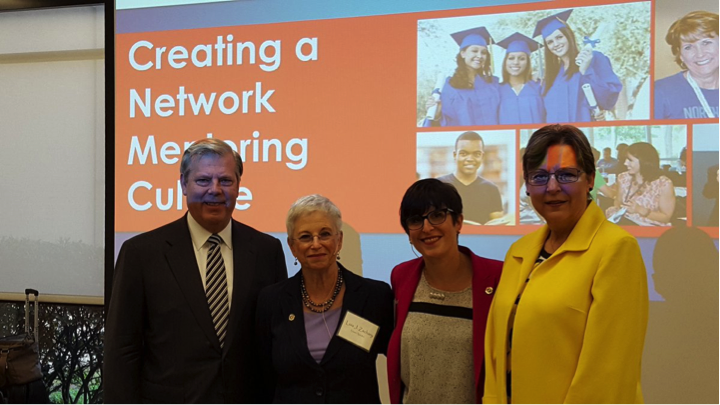
One of the highlights of this past year for us has been working with the Dallas County Community College District (DCCCD) to establish a successful mentoring culture.
DCCCD launched its Network Mentoring Culture in August by convening the Chancellor’s staff and presidents, HR representatives and other college leaders with a primary goal: to create a mentoring culture.
According to George Marquez, DCCCD’s Executive District Director of Talent Development and Division of Talent Central:
“From my perspective, successful employee engagement into the DCCCD system occurs with talent development programs and a mentoring system. We sincerely believe that the mentor component is the strongest bond that we can have in any of our employee programs because mentors provide a safe way to extend the skills and knowledge of employees through encouragement and support. Having a system of mentors also allows us to strengthen our succession planning.”
A kickoff training for Chancellors Fellows and their mentors followed a day-long consultation with DCCCD leaders.
In October we certified 18 DCCCD mentoring workshop facilitators (from seven colleges, across three locations) to conduct Starting Strong: What Mentors Need to Know and Do™ based on the book Starting Strong.
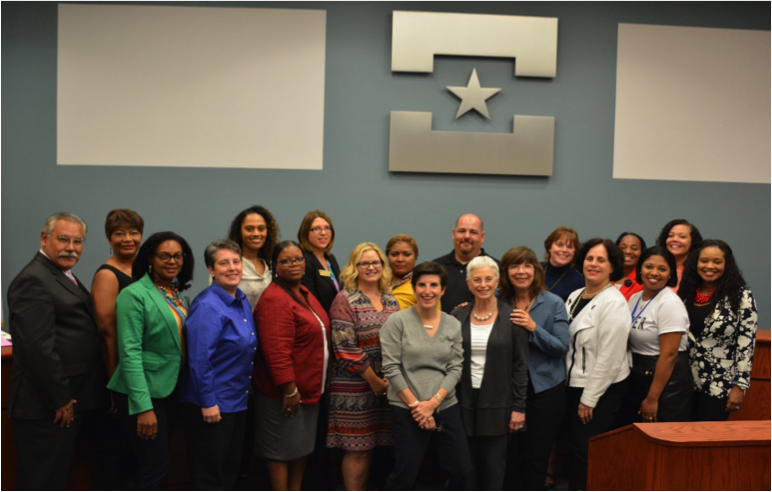
Newly certified DCCCD Starting Strong facilitators.
We were, and continue to be, impressed with the passion, commitment and talented leaders we had the privilege of certifying. Their individual contributions made the certification such a warm and welcoming experience for everyone!
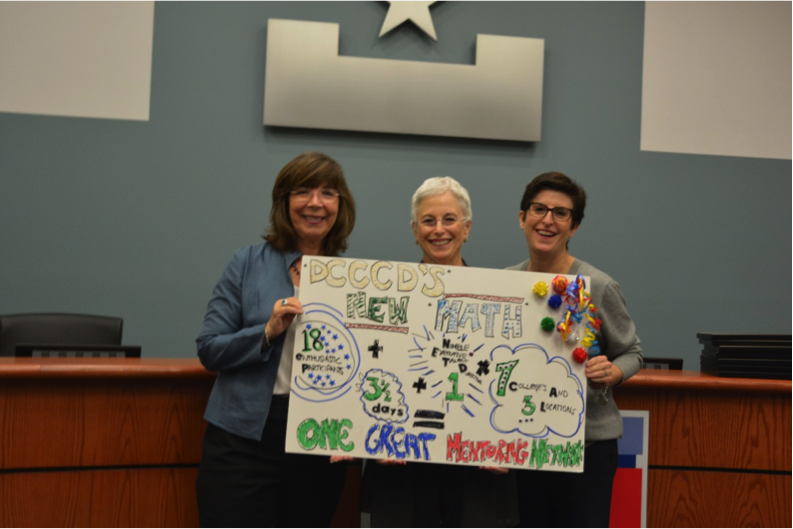
Lory Fischler, Dr. Lois J. Zachary and Lisa Fain presenting their memento.

by Center for Mentoring Excellence | Nov 22, 2016 | Facilitating Learning, Group Mentoring, Growth and Development, Mentoring Training
In September we had the privilege of working with UN Women as it launched its first formal leadership development mentoring program in Cairo, Egypt. Participants from the Ivory Coast, Egypt, Uganda, Moldova, Albania, Liberia, South Africa, Rwanda, New Delhi, Istanbul, Santo Domingo, Panama, Brussels, Copenhagen and Geneva joined us for the mentoring kickoff training.
UN Women mentees volunteered for this global initiative for a variety of reasons: They were looking to invest in their own development and take their leadership to the next level. They wanted career guidance. And they wanted candid, safe feedback. These were the things they worked on — things that would really matter!
Like other mentees we’ve worked with, this team came to mentoring with the very same concerns and questions. They wondered:
- Will I be worthy of a senior leader’s time?
- Will I be able to accomplish enough during their mentoring timetable to make the investment valuable?
- Will I feel comfortable and be able to build trust with a leader I don’t know?
- Will the feedback I receive be confidential and useful?
- Will my mentor have time in their demanding schedule to connect with me?
However, we did find some unique challenges for mentoring pairs in third-world countries, especially when trying to connect across time zones. Poor quality Internet service and gaps in time zones can make communication particularly difficult. Even so, mentoring has been value-added for these mentees, who say they appreciate the support provided by mentors and the opportunity mentoring gives them to reflect on themselves, their development and their future.
UN Women is the United Nations entity that promotes gender equality and the empowerment of women. Its Mentoring Program is designed to grow its workforce by giving mentees access to role models, tapping into networks and increasing visibility. It also helps mentors develop key leadership skills, giving them the opportunity to directly support the next generation of UN Women.


by Center for Mentoring Excellence | Sep 6, 2016 | Facilitating Learning, Growth and Development, Mentoring Communication, Mentoring Training
At first, mentoring and leadership coaching could seem like interchangeable terms for the same training program. However, when you understand the difference between the two methods, you realize, to be a strong leader, you need both. In their simplest forms, mentoring is about building valuable relationships with other people, while leadership coaching programs concentrate on improving performance.
Mentoring is a robust improvement tool customized for personal growth. Mentorship is an efficient way to help people advance in their careers while building meaningful relationships. Typically, it requires two people (a mentor and a mentee) who work in a related field and share professional experiences. Through respect and trust, the two people work together to realize the mentee’s potential and discuss a plan to achieve their goals.
Although mentoring is an essential tool for all professionals, leadership coaching is equally valuable. Through leadership coaching, you have the opportunity to hone your management skills and enhance your performance as a leader. Unlike mentoring, leadership coaching can be completed in a group or individual sessions.
Leadership coaches are often hired from outside your organization and, sometimes, your field. The separation from the company allows the coach to discuss topics and solve problems that could be unsuitable to address with your supervisor.
To make your career goals a reality, you must understand your professional path and continuously improve your performance. The simplest way to enhance your career experience is through strong relationships with a mentor as well as a leadership coach.
The Center for Mentoring Excellence offers the
tools and
training needed to help you achieve your mentoring and leadership goals. Also, we provide a variety of resources to help you strengthen your leadership abilities and boost your team’s productivity. So what are you waiting for?
Contact us today!

by Center for Mentoring Excellence | Aug 11, 2016 | Facilitating Learning, Goal Setting Conversation, Growth and Development, Making Mentoring Work For You, Mentoring Questions, Mentoring Relationships
One of the biggest parts of mentoring? Asking questions! But when should you ask questions? And when the time is right, what should you ask? Here’s a handy list of questions you should be asking your mentee over the course of your mentoring relationship:
For starting the mentoring relationship:
- How do we make this process work for you?
- What are your expectations?
- What would you recommend we do to make this work?
- What are you willing to commit to?
For goal setting:
- What is the most important thing you want to achieve?
- What can I do to help you with your leadership development?
- What is your strongest attribute?
- Where do you see your challenges?
- What would help raise your confidence level?
For pushing and challenging your mentee:
- Is this goal worthy of our time and effort together?
- What might be a challenging project for you to undertake?
- What would it be like to step out of your comfort zone?
- How is this goal going to contribute to your development?
- Did you think you are putting in sufficient effort to accomplish results?
- Why do you think there is only one solution? What else might you try?
- If you were grading your results, what grade would you give yourself?
For goal achievement:
- Did you get the results you hoped for?
- How would you approach this situation?
- Where else can you apply that?
- What is your team looking for from you?
- Is your supervisor seeing a difference?
- How else might you tackle that?
For checking in and feedback:
- What value has this provided for you thus far?
- What can we do differently to improve this relationship?
- Are we on the right path?
- What feedback have you received?
- How do you know you are making an impact?
- How can we make this work for both of us?
- How do you think you are doing?
- Are you satisfied with your results?
- Are you putting in the effort you feel you should?
- You’re quiet … what are you thinking?
- Whose feedback would be a benefit to you?
Ready to get started? Let us know how these questions help improve your mentoring relationships.
(Photo via Flickr CC: Colin_K)

by Center for Mentoring Excellence | Aug 2, 2016 | Facilitating Learning, Making Mentoring Work For You, Mentoring Relationships
So, you’ve decided that you want to start a mentoring relationship. But now what? You need to find a mentor. That might be easier said that done, however. Finding a mentor that’s a good fit for you is an important part of the mentoring process, one that is worth the effort and the time.
And it’s about more than just finding someone you like. You need to be intentional about finding a mentor, and you must consider more than personality — consider learning styles and communication styles.
Here are some things to consider as you begin your search:
- It starts with you — What are you looking to learn? What attributes are you looking for in a mentor? Knowledge, expertise, experience (or all of the above)?
- Identify your “must haves” — What do you need to have in a mentoring relationship? Make a list!
- Use your network like crazy — Tell people what you’re looking for. You never know who they might be able to introduce you to! Meet people, get contact information, research names, find out what you can. Your network is a great tool when looking for the ideal mentor.
- Go back to your list — Once you’ve collected a list of possible mentors, figure out who meets your criteria (and who doesn’t) and begin to select the ones you’d like to reach out to.
Some do’s and don’ts:
- Don’t:
- Pick someone who will be too easy on you
- Select someone just because they like you
- Choose someone because they are the most convenient
- Opt for someone because you already have a relationship
- Choose someone you report to directly
- Do:
- Seek a good learning fit between what you need and what this person has to share
- Find out if this person has sufficient time to mentor you
- Ask yourself if this person will challenge and encourage you to constantly raise the bar for yourself
- Consider if this person appears to be a good listener, has a sincere desire and willingness to mentor, and the knowledge and expertise you need.
Now the fun part: Meet them! Make sure to set up time to get to know your potential mentors, and see if they fit your mentoring criteria. Once you meet them you’ll quickly be able to tell if they are the right one for you.
(Photo via Flickr CC: Mateus Lunardi Dutra)
by Center for Mentoring Excellence | Jun 20, 2016 | Facilitating Learning, Making Mentoring Work For You
Your company has just announced a new mentoring initiative that has generated a groundswell of interest and excitement. Your supervisor has signed you up as a mentor and just let you know. Gulp! What am I in for?
You are busier than ever on top priority and high impact projects and you know there are three more waiting for you once those are completed. Additional responsibilities in your role are stressing you out.
Now you have been “voluntold” that you must participate in the initiative as a mentor.  Can you say no? How would it look if you didn’t participate? What would your supervisor think? What would it say about your ability to manage your workload?
Mentoring participation is a serious commitment. Participating because you’ve been voluntold isn’t a good enough reason to say yes. You have to want to be a mentor. It takes time and effort, and without a serious personal commitment you may well not have the energy and enthusiasm you will need to be successful.
Know that you are not alone. Peer pressure can be bad enough without being voluntold by one’s supervisor.
Here are six questions to consider before making this hard decision:
1. Do I have a sincere desire to engage in a mentoring relationship?
2. Am I willing to do the work required to prepare for mentoring meetings?
3. Do I possess the requisite knowledge, expertise or experience to mentor a mentee?
4. Do I have sufficient time right now to mentor a mentee?
5. Do I feel comfortable being a mentor?
6. What competencies or skills do I possess that would make me a good mentor?
If you can’t do the job that being a good mentor requires, It is best to speak up and say no (even if you have been voluntold).
by Center for Mentoring Excellence | May 27, 2016 | Facilitating Learning, Group Mentoring
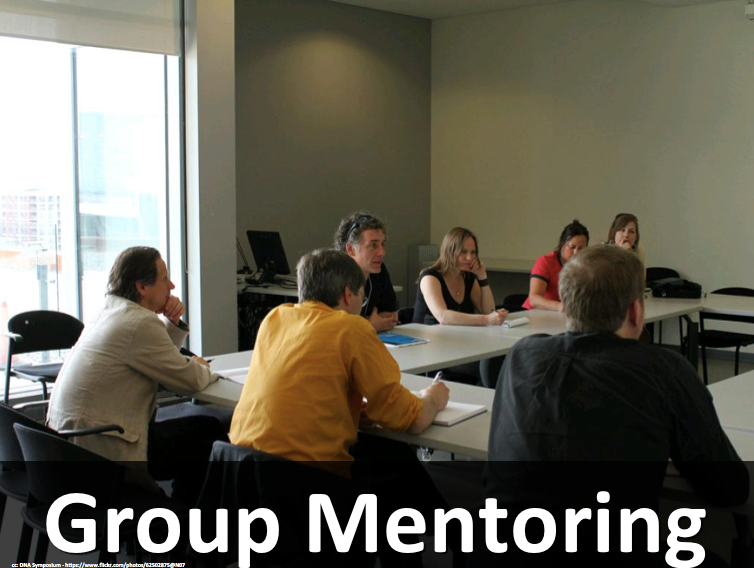
When we think of mentoring relationships, we usually think of one-on-one interactions with a mentor and a mentee. But that doesn’t always have to be the case. In fact, for many organizations, group mentoring has become an equally effective (and often more efficient) way to offer mentoring services to employees. But what is group mentoring and how does it work? Here are three ways to approach group mentoring.
Team mentoring
This one is pretty self-explanatory. A group of mentors, each with their own unique set of skills and mentoring expertise, work with mentees to give them a well-rounded and multi-faceted mentoring environment.
Note: Make sure team mentors are given the necessary tools and training to make their relationships successful.
Peer mentoring
Again, the name says it all. There’s a lot that can be learned from our fellow mentees; allowing mentees to, in turn, mentor their peers is a powerful way to reinforce mentoring practices and instill leadership qualities beyond traditional mentoring settings.
Note: Goal-setting and self-direction are key. It also helps if peer mentors have similar roles, experiences and interests.
Facilitated group mentoring
What if your mentoring journey was influenced by those seeking mentoring services just like you? Chances are, you’d be exposed to new and exciting ways of thinking. That’s the idea behind facilitated group mentoring. While you still work with a traditional mentor figure, your fellow mentees will help set agendas, group goals and influence your experience in ways you wouldn’t have otherwise been able to predict.
Note: Make sure every member of the group has a specific role and responsibility; this ensures people don’t feel left out or unheard. It also helps to limit mentoring groups to eight people or less.
So, what do you think? Is group mentoring for you? Have you tried it in the past? Let us know.