by Center for Mentoring Excellence | Jun 5, 2017 | Facilitating Learning, Growth and Development, Making Mentoring Work For You, Mentoring Communication, Mentoring Questions, Mentoring Relationships, Supporting Mentors and Mentees
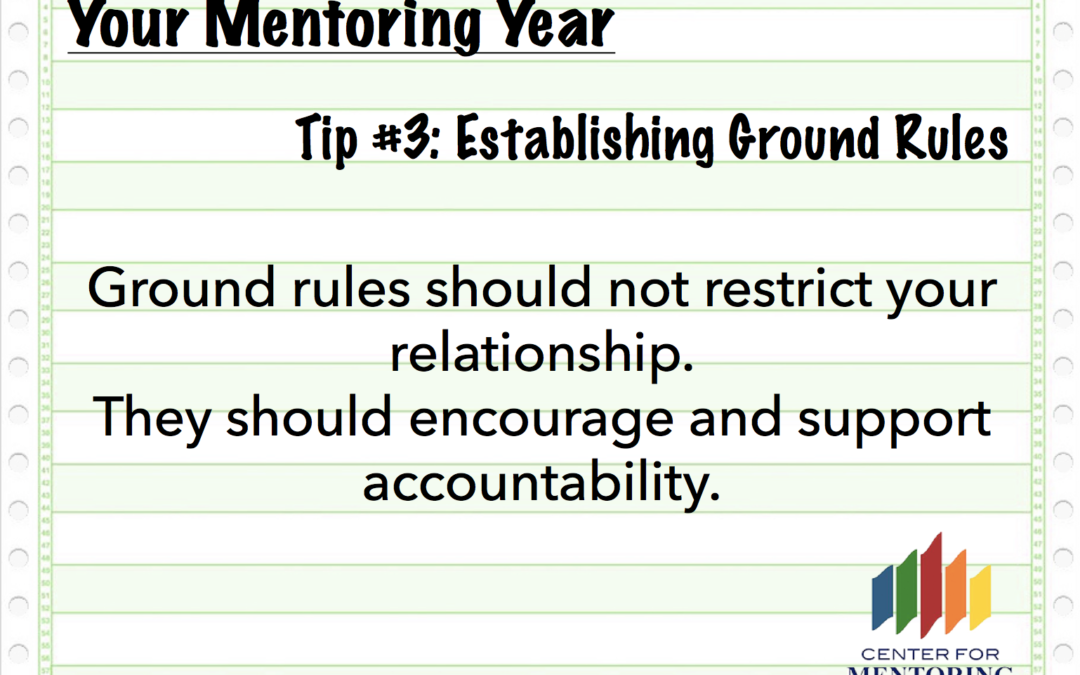
Discussing ground rules is one of the most important conversations you will ever have with your mentoring partner. Ground rules not only manage expectations in your mentoring relationship, but they also lay the foundation for building and strengthening your relationship, allowing you to focus on learning. Rather than restrict the relationship, they encourage and support accountability. Without them, you may end up spending more time managing the relationship than actually learning from your mentor. Here are some strategies for setting ground rules in place:
- Focus on:
- How you will go about allocating and managing your mentoring time
- How you want to give and receive feedback
- Your mutual role expectations
- How and when you will connect and communicate with each other
- How you will address stumbling blocks should they occur
- What steps you will follow if you need to prematurely end the relationship for any reason
- As you discuss your ground rules, keep in mind that they should not restrict your relationship. Their purpose is to encourage and support accountability.
- Once you and your mentoring partner have decided on ground rules, be sure to schedule some checkpoints to determine whether the ground rules are working for you or simply providing unnecessary obstacles.

by Center for Mentoring Excellence | Jun 1, 2017 | Goal Setting Conversation, Growth and Development, Making Mentoring Work For You, Mentoring Communication, Mentoring Questions, Mentoring Relationships, Supporting Mentors and Mentees
Lois, Lory and Lisa share many things in common when it comes to mentoring, but it’s their individual approach and unique outlook that make them such a successful team. This spirit of individuality and their complementary skills were highlighted in a recent interview, where they were asked about their passion for mentoring, what they’ve learned from mentors, and their advice to new mentors.
Here’s what they had to say:
Why are you passionate about mentoring?
LOIS: My personal mentoring stories are many. I marvel at how my mentors raised the bar for me, led by example, pushed me beyond my personally defined limits, encouraged me to enlarge my thinking, and believed in me even when I was not sure of myself. I am grateful for their time, their stories and their commitment to my growth. And, while most of my experiences were positive, there were a few that could have gone better. I had no clue then that there were things I could have done, could have said, could have asked, and could have tried that would have allowed me to make the most of my mentoring relationships. I didn’t realize that as a mentee I had an instrumental role to play in shaping the relationship and defining the outcomes of the relationship. So for me, mentoring is both personal and professional. I pay it back, every day and in every way that I can. My passion is reignited every time I work with my many diverse clients and I see how mentoring has helped them change, both themselves and the world around them.
LORY: I’ve interviewed hundreds of mentors and mentees over the past 18 years and heard their stories about breakthroughs, renewed confidence, and shifts in thinking. Their stories have inspired me. I get energized listening to people talk about their renewed sense of energy and commitment to their work because of the support and positive feedback they’ve received from mentors. I recently spoke to a mentee who told me how his mentor helped him see why certain stereotypical beliefs were holding him back and undermining his success at work. When he was finally able to turn his behaviors around, the stress and tension disappeared and new opportunities opened up. It’s exciting to see the transformative power of mentoring play itself out, time and time again.
LISA: I believe the best way to make a difference in the workplace is to help employees feel connected, valued and heard. I think that mentoring is the ideal way to accomplish this, because it creates a safe and powerful space for a mentee to gain perspective, focus on his/her own needs and ask questions that broaden their perspectives of themselves, their teams, and their organization.
What have you learned from your mentors?
LOIS: I’ve learned to listen to my own voice, to think outside the box, to let my creativity shine through, and to never give up. And that’s only the start of it. I’ve learned from observing my mentors in action, how they model the art and practice of being a reflective practitioner and asking deep, penetrating questions.
LORY: My first mentor believed that I had the skills and talent to be successful. He believed in my abilities more than I did. He inspired me to take risks and take on assignments that I would never have done without his support. I learned to believe in myself and see myself as a capable leader. My mentor also helped me understand how to think strategically and understand the politics of the institution. In a sense, he helped me see how the chess pieces moved. I learned to think several steps ahead, rather than jump in and make decisions on the fly.
LISA: I’ve learned to slow down, and to step back and think about the impact my role can have on the organization as a whole. This has helped me be more strategic and focus my own development so that I can have the greatest impact. I’ve learned to pay attention to what lights me up. I’ve learned to appreciate the positive feedback I get and to process difficult feedback constructively and in the proper context.I’ve learned a ton about the importance of developing relationships with people who believe in me and to nurture those relationships.



What are the top 3 things you’d like a new mentor to know?
LOIS:
- Pay attention to your intuition. Your gut feeling is more often right than wrong.
- Don’t be afraid of the silence. Silence allows a mentee to catch up, to process, and come up with new insights.
- You don’t need to know everything. A good question is the most powerful tool in your mentor’s toolkit.
LORY:
- Talk about your challenges and struggles with your mentee as well as your successes. It will make you more approachable and human.
- Believe in your mentees and let them know that you see their potential. They are doing the heavy lifting and your positivity helps them continue the effort.
- Push your mentee out of their comfort zone. It’s the only way they will reap real rewards.
LISA:
- Share your own experiences — the good stuff and the stuff that might not be so good. It makes a world of difference for mentees to know you are human and that you can bounce back from difficult experiences.
- Give honest but constructive feedback — and help the mentee turn it into something actionable. Mentees can make great gains if they get honest feedback from their mentors. It helps many mentees to have a space to talk about the best ways to improve.
- Check in on the relationship. If something the mentee is doing isn’t working for you, or is sabotaging their own progress, share it with them as soon as possible. Some of the greatest progress has come from mentoring relationships that started out rocky, but where the participants addresses issues openly, swiftly, and willingly.
by Center for Mentoring Excellence | May 16, 2017 | Facilitating Learning, Goal Setting Conversation, Growth and Development, Making Mentoring Work For You, Mentoring Communication, Mentoring Questions, Mentoring Relationships, Mentoring Training, Supporting Mentors and Mentees
Listening is an essential mentoring skill and, once again, it topped our Wheelhouse Mentoring Survey list as the number one attribute of a good mentor.
Thanks to the responses of our readers (like you!) we also collected the following additional characteristics of good listeners:
- Uses active listening.
- Provides a safe environment for a mentee to share and take risks.
- Demonstrates empathy.
- Picks up on all the subtle (or not so subtle) clues to tailor appropriate responses.
- Is nonjudgmental and has unconditional positive regard for their mentee.
- Keeps an open mind.
- Is truly, authentically interested in the development of their mentee.
- Encourages mentees to come up with solutions themselves by asking probing questions.
- Stays focused on their mentee.
- Possesses the humility to accept that they don’t know all the best ways of doing things.
- Remains fully present in the conversation.
- Listens and learns; doesn’t just share their expertise.

Here’s an example of how listening should work in a mentoring relationship, and why it’s so important:
Kasi wanted someone to listen and understand her concerns and challenges. Jonah, her mentor, got it and got her.
Kasi: “I feel like I’m stuck. I don’t see where I can go and grow in this organization. Maybe I need to go back to school and get an MBA.”
Jonah: “Feeling stuck is no fun. I think everyone feels that way at one time or another in their career. I know I’ve been there. I found, both for me and many others who have shared those feelings, it isn’t always the long range career path. Sometimes it is a short term lull — like what you are doing now doesn’t interest you anymore. Does that make sense?”
Kasi: “Yes it does, I don’t feel like I am working on interesting projects anymore. All the new projects seem to be going to others. I feel like I am being left behind.”
Jonah: “That, I know, is not a good feeling. When you see others get what appears to be the latest and greatest project, it can easily make you second guess yourself. I just want to remind you of what you told me before in our earlier conversations. And that is your supervisor values your work, and you are well-respected. So I don’t believe it has to do with your contribution. Have you talked to your supervisor about these feelings of yours and about a new assignment?”
Kasi: “I haven’t. I guess I had hoped I would be the natural go-to person when something new came up.”
Jonah: “Well, I am sure that might have been your hope, but I can tell you, as a supervisor, that, number one, I am not a mind reader. I don’t always know that someone wants a new assignment, and two, I do tend to rely on people like you who are responsible and can get the job done. I give them free reign to do their work and appreciate that I don’t have to watch over them. I guess this is a reminder for me, too. Not to take their contribution for granted.”
Kasi: “So you think I need to be speaking up more about what I need, not just put my head down and get the job done?”
Jonah: “I do. Let’s give it a try.”
Seems pretty straightforward, right? As you can see, Jonah is a mentor who listens. He refers back to previous conversations, showing he’s invested in Kasi. He also acknowledges what she’s feeling, listens to the words she’s using, and digs deeper into why she’s feeling the way she does.
What’s great about this example, too? It showcases several other top qualities listed in our survey — empathy, focus, nonjudgmental, etc. A truly great mentor combines these top qualities into an unforgettable experience for their mentees!
Key Takeaway: How well are you listening? Use the top 12 qualities in this post to help you benchmark your listening skills.
by Center for Mentoring Excellence | May 8, 2017 | Facilitating Learning, Growth and Development, Making Mentoring Work For You, Mentoring Communication, Mentoring Questions, Mentoring Relationships, Supporting Mentors and Mentees
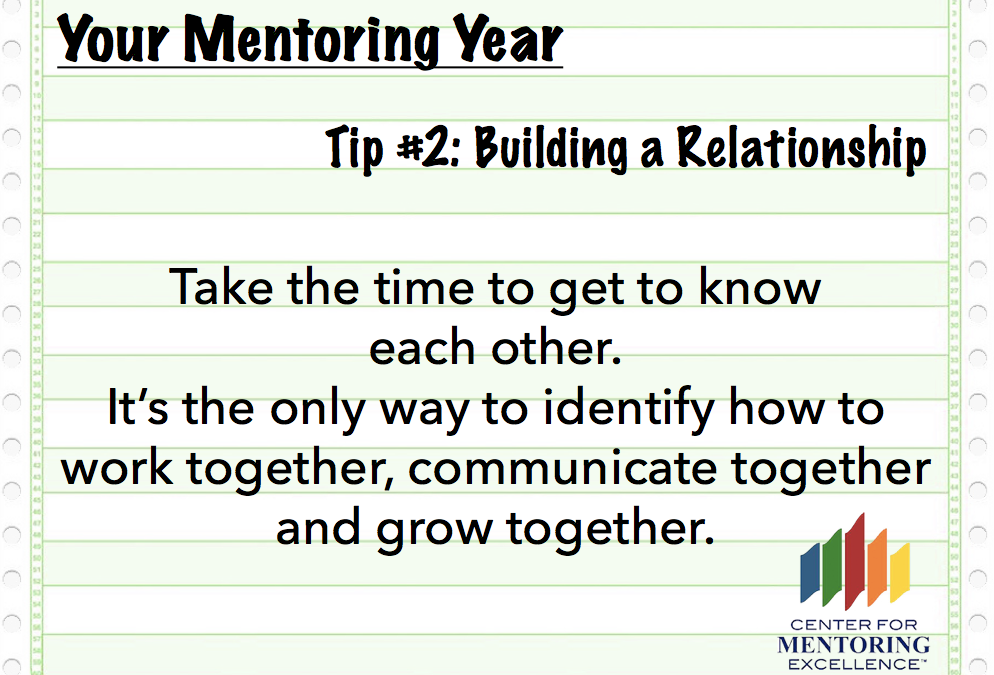
Taking the time to work on a mentoring relationship is not always easy. But these relationships are truly the heart of any successful mentoring endeavor. In fact, it’s often a prerequisite for success. Mentors and mentees who discuss their relationship expectations end up experiencing exponentially more success than those who don’t.
One mentee, an associate at a large law firm, lamented that the relationship wasn’t working because her mentor focused only on the path to partnership. The mentee told us, “That’s not appealing to me. It’s like preparing for a pie-eating contest where the prize is more pie.” That mentoring pair was ultimately unsuccessful because they didn’t take the time to learn how each other tick.
Here are some questions to ask your mentoring partner that will set a strong foundation for the relationship:
- What motivates you in your career?
- How do you learn best? Do you need time to process alone, or do you process best by “thinking aloud”?
- What are your pet peeves?
- Do you like to read? Are you open to article and/or book suggestions? Would that be welcome or feel burdensome?
- Have you had a mentor/mentee in the past? What worked in that relationship? What did not work?
Missed Tip #1? Find it here. And make sure to come back next month for Tip #3!
by Center for Mentoring Excellence | Apr 5, 2017 | Facilitating Learning, Growth and Development, Making Mentoring Work For You, Mentoring Communication, Mentoring Questions, Mentoring Relationships, Supporting Mentors and Mentees
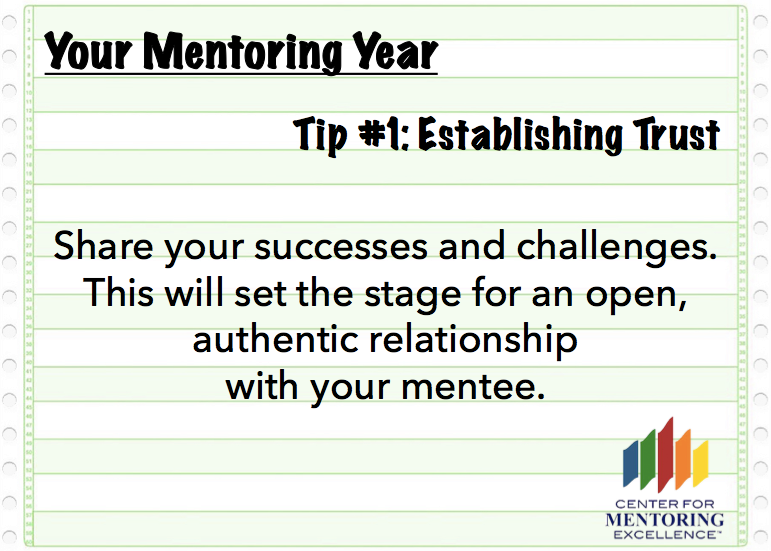
Trust is everything when starting out in a new mentoring relationship — and even when you’re nurturing an existing one! While it’s tempting to dive in and drill down quickly to talk about needs and goals at the first meeting, try to avoid this. Instead, focus first on establishing an open and authentic relationship. It takes time and attention, but in the long run, it’s well worth it. You will have established a deeper, more meaningful, trusting relationship. Here are some things to keep in mind:
- Get to know your mentee, and let your mentee get to know you. To jump start the process, come prepared with a list of questions. What is it you want to know about your mentee as a person? What do you want to know about your mentee’s work context?
- Your mentee needs to relate to you, too. Mentees are more forthcoming when a mentor shares their personal success stories, as well as their struggles. If you’re open and authentic, it invites your mentee to be, too.
Check back soon for “Your Mentoring Year” Tip #2!

by Center for Mentoring Excellence | Aug 11, 2016 | Facilitating Learning, Goal Setting Conversation, Growth and Development, Making Mentoring Work For You, Mentoring Questions, Mentoring Relationships
One of the biggest parts of mentoring? Asking questions! But when should you ask questions? And when the time is right, what should you ask? Here’s a handy list of questions you should be asking your mentee over the course of your mentoring relationship:
For starting the mentoring relationship:
- How do we make this process work for you?
- What are your expectations?
- What would you recommend we do to make this work?
- What are you willing to commit to?
For goal setting:
- What is the most important thing you want to achieve?
- What can I do to help you with your leadership development?
- What is your strongest attribute?
- Where do you see your challenges?
- What would help raise your confidence level?
For pushing and challenging your mentee:
- Is this goal worthy of our time and effort together?
- What might be a challenging project for you to undertake?
- What would it be like to step out of your comfort zone?
- How is this goal going to contribute to your development?
- Did you think you are putting in sufficient effort to accomplish results?
- Why do you think there is only one solution? What else might you try?
- If you were grading your results, what grade would you give yourself?
For goal achievement:
- Did you get the results you hoped for?
- How would you approach this situation?
- Where else can you apply that?
- What is your team looking for from you?
- Is your supervisor seeing a difference?
- How else might you tackle that?
For checking in and feedback:
- What value has this provided for you thus far?
- What can we do differently to improve this relationship?
- Are we on the right path?
- What feedback have you received?
- How do you know you are making an impact?
- How can we make this work for both of us?
- How do you think you are doing?
- Are you satisfied with your results?
- Are you putting in the effort you feel you should?
- You’re quiet … what are you thinking?
- Whose feedback would be a benefit to you?
Ready to get started? Let us know how these questions help improve your mentoring relationships.
(Photo via Flickr CC: Colin_K)