by Center for Mentoring Excellence | Aug 2, 2016 | Facilitating Learning, Making Mentoring Work For You, Mentoring Relationships
So, you’ve decided that you want to start a mentoring relationship. But now what? You need to find a mentor. That might be easier said that done, however. Finding a mentor that’s a good fit for you is an important part of the mentoring process, one that is worth the effort and the time.
And it’s about more than just finding someone you like. You need to be intentional about finding a mentor, and you must consider more than personality — consider learning styles and communication styles.
Here are some things to consider as you begin your search:
- It starts with you — What are you looking to learn? What attributes are you looking for in a mentor? Knowledge, expertise, experience (or all of the above)?
- Identify your “must haves” — What do you need to have in a mentoring relationship? Make a list!
- Use your network like crazy — Tell people what you’re looking for. You never know who they might be able to introduce you to! Meet people, get contact information, research names, find out what you can. Your network is a great tool when looking for the ideal mentor.
- Go back to your list — Once you’ve collected a list of possible mentors, figure out who meets your criteria (and who doesn’t) and begin to select the ones you’d like to reach out to.
Some do’s and don’ts:
- Don’t:
- Pick someone who will be too easy on you
- Select someone just because they like you
- Choose someone because they are the most convenient
- Opt for someone because you already have a relationship
- Choose someone you report to directly
- Do:
- Seek a good learning fit between what you need and what this person has to share
- Find out if this person has sufficient time to mentor you
- Ask yourself if this person will challenge and encourage you to constantly raise the bar for yourself
- Consider if this person appears to be a good listener, has a sincere desire and willingness to mentor, and the knowledge and expertise you need.
Now the fun part: Meet them! Make sure to set up time to get to know your potential mentors, and see if they fit your mentoring criteria. Once you meet them you’ll quickly be able to tell if they are the right one for you.
(Photo via Flickr CC: Mateus Lunardi Dutra)
by Center for Mentoring Excellence | Jun 20, 2016 | Facilitating Learning, Making Mentoring Work For You
Your company has just announced a new mentoring initiative that has generated a groundswell of interest and excitement. Your supervisor has signed you up as a mentor and just let you know. Gulp! What am I in for?
You are busier than ever on top priority and high impact projects and you know there are three more waiting for you once those are completed. Additional responsibilities in your role are stressing you out.
Now you have been “voluntold” that you must participate in the initiative as a mentor.  Can you say no? How would it look if you didn’t participate? What would your supervisor think? What would it say about your ability to manage your workload?
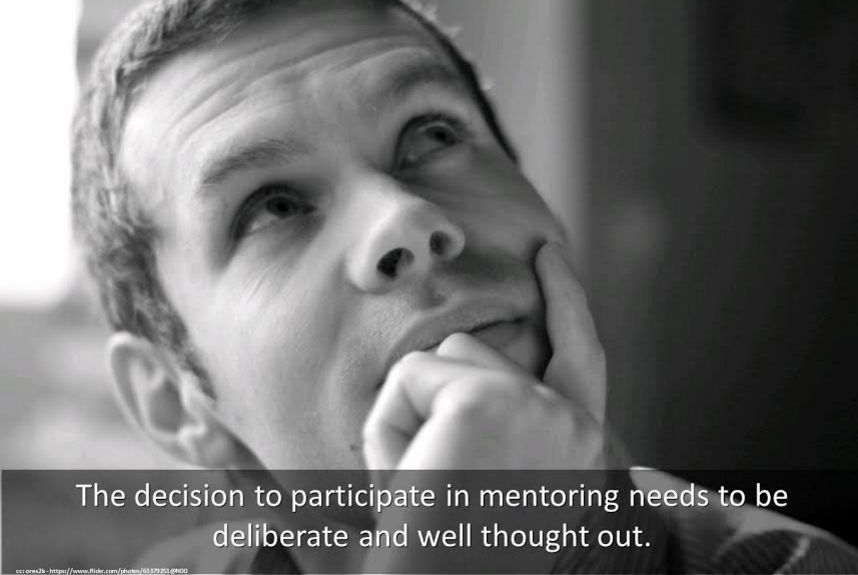
Mentoring participation is a serious commitment. Participating because you’ve been voluntold isn’t a good enough reason to say yes. You have to want to be a mentor. It takes time and effort, and without a serious personal commitment you may well not have the energy and enthusiasm you will need to be successful.
Know that you are not alone. Peer pressure can be bad enough without being voluntold by one’s supervisor.
Here are six questions to consider before making this hard decision:
1. Do I have a sincere desire to engage in a mentoring relationship?
2. Am I willing to do the work required to prepare for mentoring meetings?
3. Do I possess the requisite knowledge, expertise or experience to mentor a mentee?
4. Do I have sufficient time right now to mentor a mentee?
5. Do I feel comfortable being a mentor?
6. What competencies or skills do I possess that would make me a good mentor?
If you can’t do the job that being a good mentor requires, It is best to speak up and say no (even if you have been voluntold).
by Center for Mentoring Excellence | May 27, 2016 | Facilitating Learning, Group Mentoring
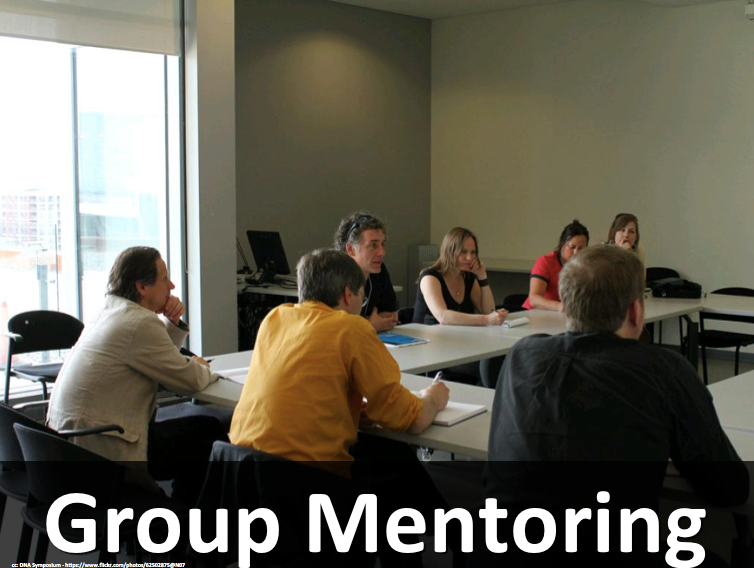
When we think of mentoring relationships, we usually think of one-on-one interactions with a mentor and a mentee. But that doesn’t always have to be the case. In fact, for many organizations, group mentoring has become an equally effective (and often more efficient) way to offer mentoring services to employees. But what is group mentoring and how does it work? Here are three ways to approach group mentoring.
Team mentoring
This one is pretty self-explanatory. A group of mentors, each with their own unique set of skills and mentoring expertise, work with mentees to give them a well-rounded and multi-faceted mentoring environment.
Note: Make sure team mentors are given the necessary tools and training to make their relationships successful.
Peer mentoring
Again, the name says it all. There’s a lot that can be learned from our fellow mentees; allowing mentees to, in turn, mentor their peers is a powerful way to reinforce mentoring practices and instill leadership qualities beyond traditional mentoring settings.
Note: Goal-setting and self-direction are key. It also helps if peer mentors have similar roles, experiences and interests.
Facilitated group mentoring
What if your mentoring journey was influenced by those seeking mentoring services just like you? Chances are, you’d be exposed to new and exciting ways of thinking. That’s the idea behind facilitated group mentoring. While you still work with a traditional mentor figure, your fellow mentees will help set agendas, group goals and influence your experience in ways you wouldn’t have otherwise been able to predict.
Note: Make sure every member of the group has a specific role and responsibility; this ensures people don’t feel left out or unheard. It also helps to limit mentoring groups to eight people or less.
So, what do you think? Is group mentoring for you? Have you tried it in the past? Let us know.
by Center for Mentoring Excellence | Aug 4, 2015 | Facilitating Learning, Making Mentoring Work For You, Mentoring Communication, Mentoring Relationships
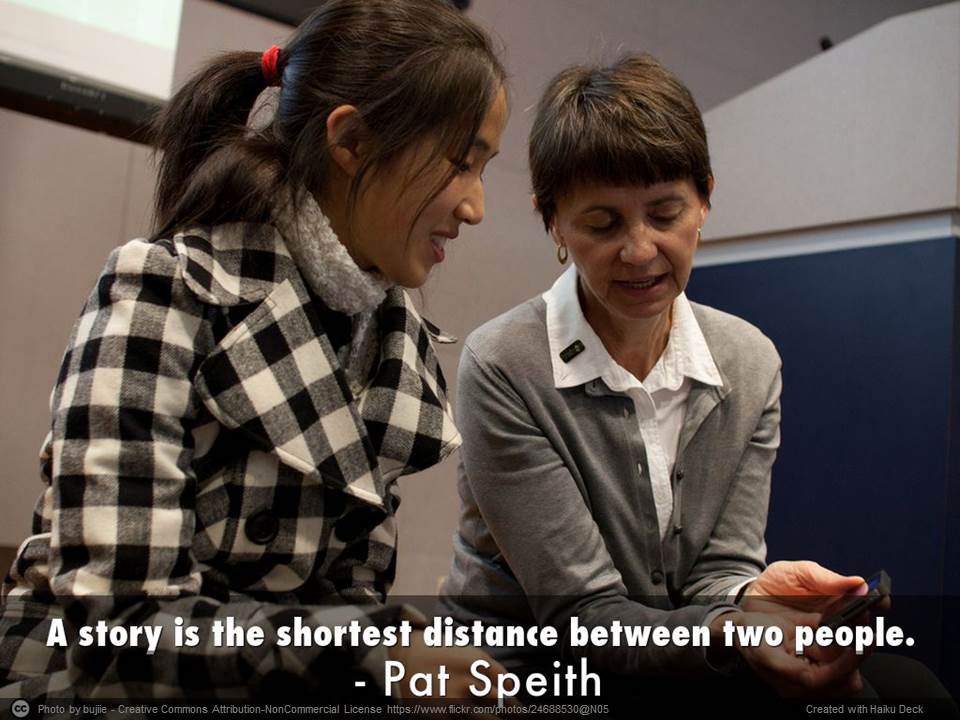
“A story is the shortest distance between two people.”
— Pat Speith
Sharing personal stories, successes and challenges serves multiple purposes in a mentoring relationship.
- Stories build trust, keep a mentoring relationship real, create a comfort level, and give your mentee “permission” to share their own.
Hearing stories about your career and personal challenges provides a powerful impetus for mentees to take action.
- Your setbacks remind them that successful people do face and overcome roadblocks.
By sharing strategies for solving problems and dealing with adversity your mentee learns from your experience.
- According to psychologist Uri Hasson, “Anything you’ve experienced, you can get others to experience the same.” People accept ideas more readily when their minds are in story mode.
Telling your stories and sharing your learning demonstrates openness and respect, and builds trust.
- It creates points of connection, a shared language, and grist for ongoing conversation.
Your story motivates mentee self-reflection.
- It activates their brain cells, stimulates critical and creative thinking, and increases their self-awareness.

So, what is your story?
How can you tell it in such a way that it invites conversation, reflection and learning?
Encourage your mentees to share their stories by:
1. Sharing yours
2. Thinking, in advance, about what you really want to know about them
3. Asking specific questions to encourage them to reflect on their career path, specific experiences, previous successes, and work projects
4. Listening closely to what they say, how they say it, and the words they use to describe their experiences
5. Asking probing questions to encourage them to reflect on the lessons they have learned from their stories
by Center for Mentoring Excellence | May 15, 2015 | Facilitating Learning
We recently talked about the top ten best practices for mentors. But what about the mentees? Don’t worry, we have you covered!
Here are top ten mentee best practices from our 2015 Mentoring Matters Reader Survey:
1. Focus on achieving learning goals
- Learning is the purpose and the payoff of mentoring. It’s easy to get sidetracked and lose focus. After three cups of coffee and little work on leadership development, mentoring fizzles out. Goals help you stay focused, moving in a positive direction, and benchmark your progress.
2. Expect to drive the mentoring relationship
- Mentors are not mind readers. Be prepared to ask for what you need, when you need it. They won’t know what you need unless you tell them.
3. Create SMART goals that will contribute to your development
- Fuzzy goals result in fuzzy outcomes. Make sure your goals are crystal clear to you and your mentor. Goals need to be specific, measurable, achievable, realistic and timely.
4. Be authentic, open and honest
- Your willingness to be vulnerable makes a significant difference in your growth and development. If you pretend that all is perfect, your mentor will never get to know the real you, and you will miss out on real learning opportunities.
5. Prepare for all mentoring meetings
- Advance preparation for mentoring sessions will save time, make meetings more efficient and result in more meaningful learning.
6. Stay connected and in communication with your mentor
- Utilize multiple ways to stay connected to your mentor. Regular and consistent communication is the name of the game, whether it’s face-to-face, email, Skype or telephone calls, the operative word is “and.”
7. Be willing to stretch and step out of your comfort zone
- Expect your mentor to challenge you with questions and learning opportunities that might take you outside your comfort zone. They may initially make you uncomfortable, but the stretch is what will maximize your learning.
8. Ask for specific feedback
- Your mentor’s honest and candid feedback will contribute to your self-awareness and get you to the next level. Practice asking for specific feedback and be prepared to receive it without being defensive. Share feedback with your mentor and act on what you hear.
9. Focus on the future
- It’s easy to get bogged down in day-to-day issues instead of focusing on your future. Keep in mind that mentoring creates momentum towards your future development. Be prepared to articulate your vision for yourself so that you and your mentor can create strategies for your future success.
10. Keep a journal
- You will want to make notes of conversations that reflect your learning, and also track your mentoring progress. A journal is a great place to record insights and questions in preparation for mentoring meetings. Although keeping a journal requires discipline and practice, it’s well worth the effort.
If you have other best practices that you’d like to add, please let us know!
by Center for Mentoring Excellence | Jan 23, 2015 | Facilitating Learning, Growth and Development, Making Mentoring Work For You, Mentoring Relationships
Starting Strong walks you through several fictional mentoring examples, highlighting the importance of the first 90 days of a mentoring relationship and pointing out invaluable conversations to have.
One of those fictional examples introduces readers to Rafa.
Rafa is a composite of hundreds of mentees we have worked with over the past 15 years. He’s an ambitious Millennial, and impatient to make it big and fast. To help him on his professional path, Rafa’s company has matched him with a savvy and experienced mentor. This is new for him, and he has no clue what to expect from a mentoring relationship.
Sound familiar? If you’re someone who is new to mentoring like Rafa, our new book, Starting Strong, can help you jumpstart your mentoring relationship and get it on solid footing right from day one.
Starting Strong models mentoring best practices by taking you inside a mentoring relationship, allowing you to observe, feel and experience six key mentoring conversations as they take place.
 As the story evolves over the first 90 days of their mentoring relationship, Rafa comes to appreciate the importance of a good launch, and the critical role preparation plays in moving forward. He learns many lessons about how to build a trusting, open and honest relationship, how to maximize his mentoring time, and how to take charge of his own learning.
The Conversation Playbook that follows the story is jam-packed with strategies, tips and probing questions that you can use to your advantage while working with your mentees.
Here are five ways to use Starting Strong to deepen your relationship, stay on track and raise the level of your mentoring practice:
- Invite your mentees to read Starting Strong and discuss Rafa’s experiences.
- During one of your initial sessions with your new mentee, address the questions at the end of each chapter.
- Prepare for your mentoring meetings by selecting questions from the playbook to deepen your mentoring conversations.
- When you bring your mentoring relationship to closure, give your mentee a copy of Starting Strong as a gift. It will help them prepare for the transition from mentee to mentor.
- And, don’t forget to benchmark your mentoring practices against those described in the book.
Purchase your copy of Starting Strong today!